- Vendry
- Posts
- Vol. 116 Canva: The SEO machine 🎨
Vol. 116 Canva: The SEO machine 🎨
How Canva turned programmatic SEO into a global growth engine

Case Studied
February 17, 2026

Case Studied
Owning the long tail
In the SaaS world, growth often comes down to one question: how do you show up exactly when someone needs you?
We’ve seen brands like Zapier and monday.com build massive traffic engines using a strategic SEO strategy. And Canva is squarely seated among these massive SEO success stories.
This week, Case Studied explores how Canva drove massive organic traffic through a programmatic SEO strategy.
The Brief

Founded in 2013 in Australia, Canva set out to make design accessible to everyone, regardless of education, training, or experience. Over the past decade, it’s evolved into a multi-product platform serving individuals, businesses, teachers, and enterprises across more than 190 countries.
Today, Canva is valued at $42 billion, making it one of the most valuable woman-founded and woman-led companies. It also sits alongside Atlassian as one of the most valuable tech companies to come out of Australia.
The brand reported in October 2025 that it has 260 million users, including 29 million monthly paid subscribers, and $3.5 billion in annualized revenue.
While Canva is widely considered a go-to design tool for laypeople now, the path to that popularity was paved by a programmatic SEO strategy. The brand focused on building an SEO engine that could capture millions of highly specific, high-intent searches across categories, industries, and languages.
The Execution

Canva built its large-scale programmatic SEO engine by focusing mainly on structured landing pages for each of their design templates.
Each page was tailored to a specific keyword and included a design preview and a description packed with keywords (not to mention a user-friendly interface). And these pages rank for millions of long-tail keywords.
Canva focused on two main types of landing pages based on search intent. One targeted templates—i.e. “wedding invitation templates.” The other targeted creations—i.e. “create custom wedding invitations.” In targeting these kinds of queries, Canva situated itself at the top of the Google results pages for specific searches that weren’t as competitive as more generic searches.
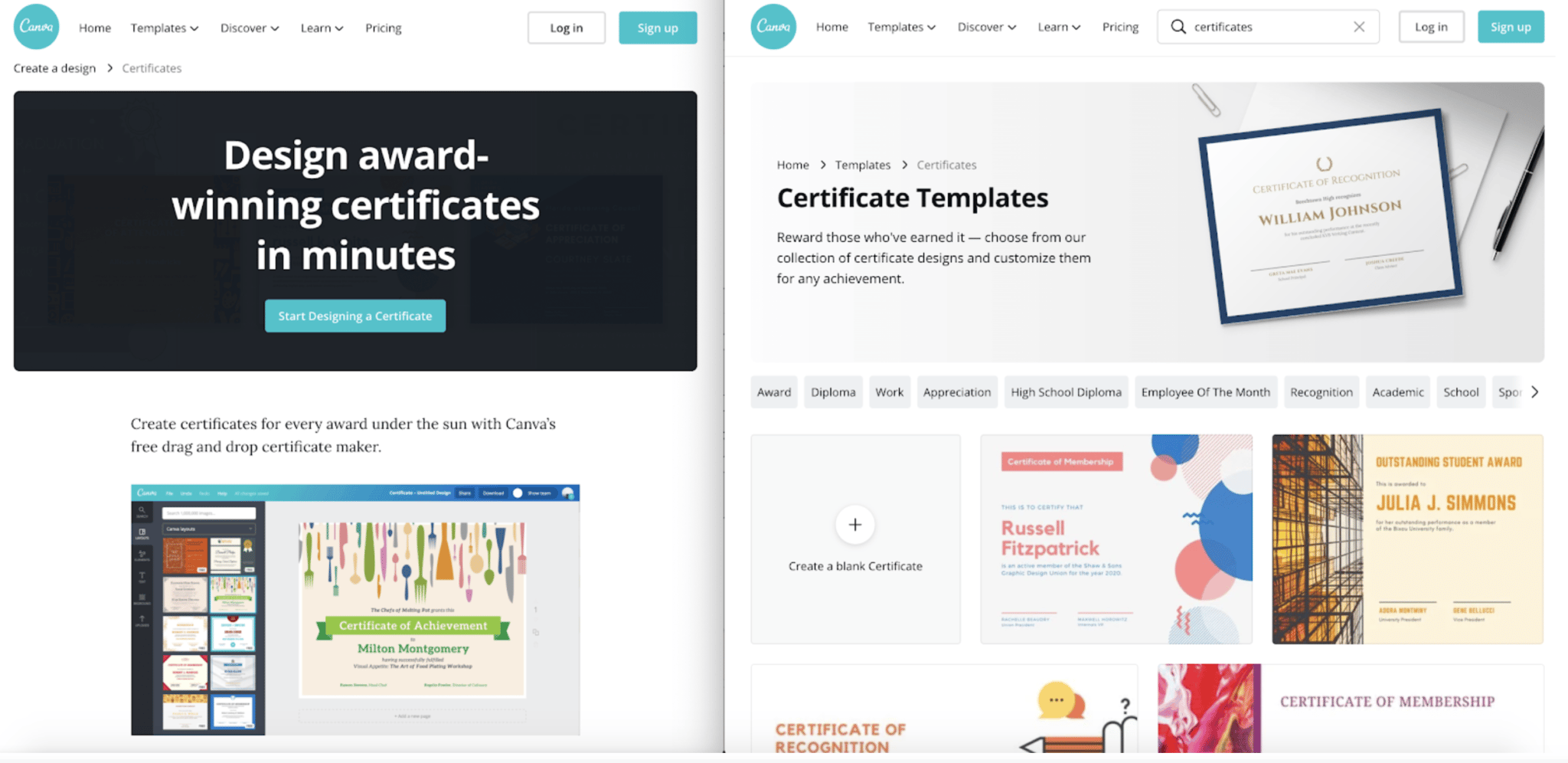
Canva also built a parent-child relationship among its pages, with child pages that captured backlinks and generated significant traffic. For example, the “Invitations” category has a whopping 900 backlinks and generates over 65,000 organic visitors per month through the parent and child pages.
It’s also worth noting that Canva continuously builds these SEO pages in response to demand. When the COVID-19 pandemic hit and forced many folks to work from home, the demand for “Zoom backgrounds” spiked. Canva reacted by creating a new landing page for “Customizable Zoom backgrounds” that had 352 backlinks.
The Results

Canva’s programmatic SEO strategy helped transform it into one of the most visited websites in the world.
According to Ahrefs, the company saw 252 million visits in February 2026 and it’s linked by 346,700 websites. Canva.com ranks No.4 in top computers and electronics websites in the world by Ahrefs organic search traffic estimates, sitting behind only chatgpt.com, apple.com, and microsoft.com.
The Takeaways
1) Create a scalable SEO structure.
Canva didn’t scale traffic by publishing one-off blog posts. They built structured, repeatable page systems that could generate thousands of SEO-optimized experiences tied directly to user intent.
Consider what repeatable page structures could help your team build more long-tail queries. Identify what categories to focus on and build out your assets from there with varied types of content: lists, interviews, free resources, etc.
2) Build around intent.
Canva’s SEO strategy targeted highly specific and less competitive searches. By aligning pages to what users were actively trying to accomplish, the brand captured traffic at the exact moment of intent.
When building your SEO strategy, prioritize intent over search volume. Long-tail queries often signal stronger purchase or action readiness. Ranking for thousands of precise, smaller keywords can be more beneficial than one massive, competitive term.
3) Let your product power your SEO.
Canva’s highest-ranking pages are directly tied to its core product experience. Users land on a template page and can start designing immediately with no additional navigation required. That tight alignment between SEO and product reduces friction and increases activation.
Look for ways your product can serve as the destination, not just the CTA. Interactive tools, demos, calculators, or sample workflows can double as SEO landing pages. When search pages are functional, they convert better and create stronger user retention.
End the search: Vendry makes it simple to find your next agency partner. Share your needs and get connected with vetted, top-tier options in under a week—at no cost to you.