- Vendry
- Posts
- Vol. 109 Starbucks: Red Cups galore ☕
Vol. 109 Starbucks: Red Cups galore ☕
How Starbucks achieved the company’s biggest sales day ever in North America

Case Studied
December 23, 2025

Case Studied
A new holiday record
Predictability in marketing is often treated as a liability. Annual promotions risk fatigue and repeated mechanics risk feeling stale.
But Starbucks has spent years proving that’s not always the case. With their annual Red Cup Day promotion, the company has trained customers to show up, spend, and participate on a specific day each year. And in 2025, they came out in larger-than-usual droves.
This week, Case Studied explores how Starbucks achieved the company’s biggest sales day ever in the North American market
The Brief
Founded in 1971, Starbucks operates more than 38,000 stores globally and over 10,000 company-owned locations in the US.
In recent years, the company’s faced slowing sales, long wait times, and pressure around the in-store experience. As part of their efforts to address these challenges, they appointed former Chipotle CEO Brian Niccol as their sixth chief executive in 2024.
Following Niccol’s appointment, Starbucks outlined a “Back to Starbucks” strategy that focused on restoring fundamentals at the store level. The approach emphasized a simplified menu to reduce wait times and improve quality, plus selective store openings, renovations, and closures to optimize the footprint.
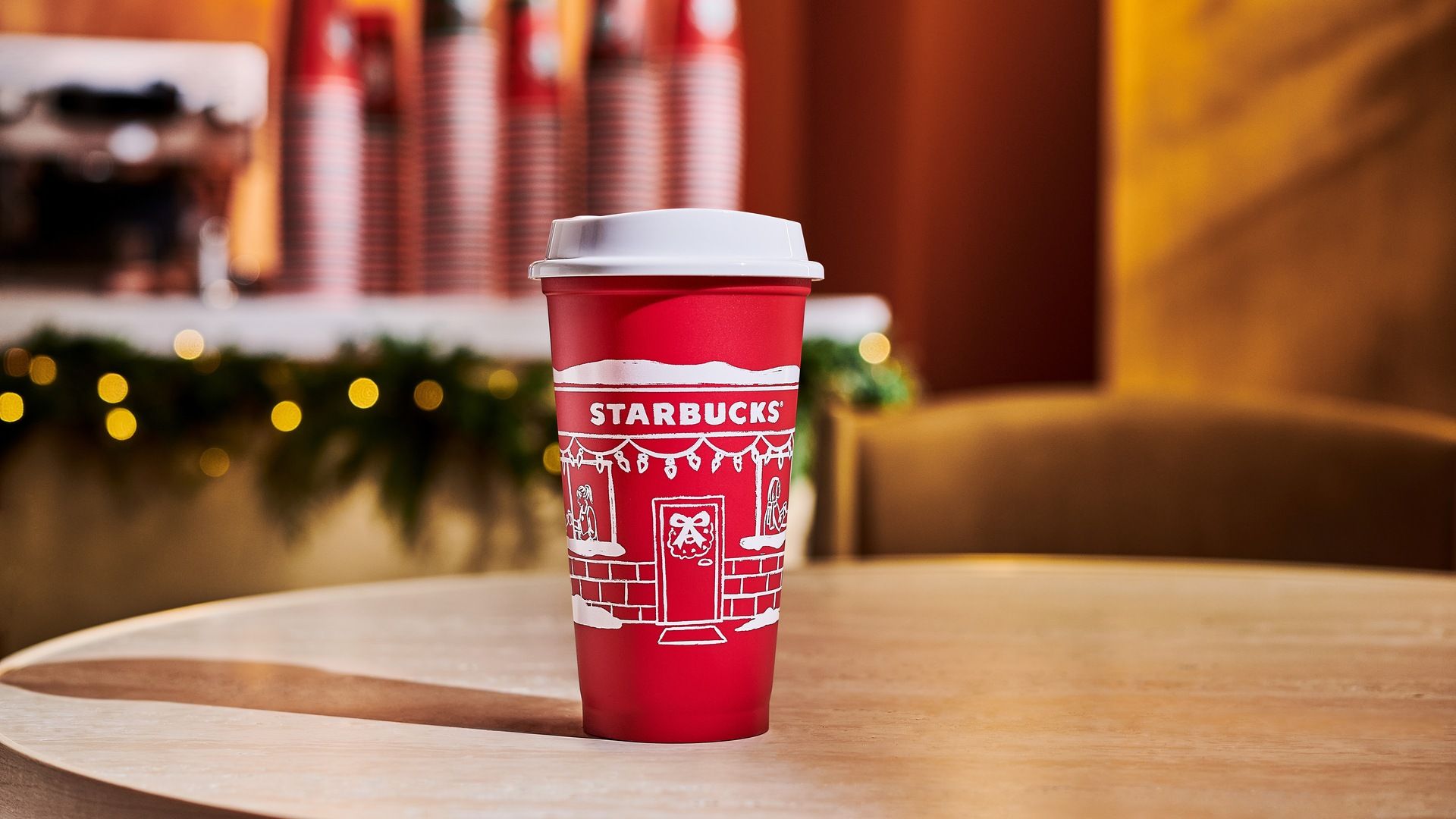
Now to Red Cup Day. This highly anticipated holiday kickoff is timed with the debut of Starbucks’ holiday menu. Here’s how it works: Customers who purchase a qualifying holiday beverage receive a free, limited-edition reusable red cup that’s available while supplies last. Over time, these red cups have become fan-favorite collectibles.

But in 2025, the event arrived amid continued labor organizing. Starbucks Workers United, the union representing some Starbucks baristas, organized what it called a “Red Cup Rebellion.” It was a series of worker strikes intentionally timed on Red Cup Day. The action was designed to draw attention to staffing levels, scheduling, and working conditions during one of the company’s busiest days.
According to Starbucks, the labor action affected fewer than 1% of its U.S. coffeehouses, with the overwhelming majority of company-owned locations remaining open and operating as normal. While the strikes created localized disruption and media coverage, Starbucks did not alter the Red Cup Day promotion or messaging in response.
The Execution

Starbucks launched its 2025 Red Cup Day at physical stores, with promo creative across owned and paid channels.
The structure was intentionally simple. The company announced the date as well as photos of the cup one day before launch, which was organically picked up and shared across social.
This year’s cup design is a hand-drawn sketch by Starbucks designer Yvonne Chan, who said it’s, “inspired by the little moment of magic you feel when you step into a Starbucks from the cold outside.” The design choice ladders up to the broader Back to Starbucks strategy that emphasizes simplicity over heavy branding.
In support of the in-store moment, Starbucks rolled out promo for the event across social. But all in all, the company largely relied on the event’s established behavioral loop: customers visiting stores early, receiving a limited-availability item, and sharing it organically across social platforms.

The Results

Despite operational headwinds with the labor strike, Niccols said the Starbucks 2025 Red Cup Day was the company’s biggest sales day ever in the North American market.
According to Placer.ai data, customer traffic jumped 45% on the day of the giveaway. Their data also shows that foot traffic this year was 8.2% higher than the 2023 Red Cup Day and 3.1% higher than the 2024 event.
The reusable cups quickly appeared across social platforms, generating widespread earned visibility, as well as earned media coverage.
The Takeaways
1) Build brand traditions.
Red Cup Day strikes a unique balance. While the structure of the promotion offers consistency and simplicity, the design of the cups offers surprise and delight. The surprise helps the brand avoid feeling stale, while the consistency helps them build trust.
For your brand, resist the urge to abandon repeatable moments out of fear of fatigue. Traditions gain strength through repetition. And when customers know what’s coming and when, participation becomes habitual.
2) Use marketing moments to reinforce broader strategic shifts.
Red Cup Day didn’t operate in isolation. This year’s promotion aligned with the direction of Niccols’ Back to Starbucks strategy by keeping the mechanic straightforward, store-first, and operationally disciplined. It reinforced familiarity and service at scale rather than adding complexity.
For brands undergoing strategic resets, major marketing moments can serve as important proof points. Use your most visible activations to demonstrate that broader changes are working in practice. When tentpole promotions reflect day-to-day operational improvements, customers don’t just hear about the strategy, they experience it firsthand.
3) Design for participation.
Starbucks focused on making Red Cup Day inherently participatory. The limited-edition reusable cups gave customers something tangible to engage with and share. And the design itself carried a brand message, meaning in-store participation = organic visibility.
To apply this, focus on creating experiences or assets that invite involvement rather than explanation. When people feel like they’re taking part in a moment, they’re more likely to talk about it and return for it again next year.
End the search: Vendry makes it simple to find your next agency partner. Share your needs and get connected with vetted, top-tier options in under a week—at no cost to you.