- Vendry
- Posts
- Vol. 111 A24: Cutting through noise ✂️
Vol. 111 A24: Cutting through noise ✂️
How how A24 is disrupting traditional movie marketing

Case Studied
January 13, 2026
Today’s Case Studied is sponsored by HubSpot.
The most effective campaigns are multi-channel. But video production bottlenecks kill momentum. The Descript app for HubSpot lets you move from one shoot to full campaign deployment—fast.
Case Studied
Making cultural moments
Movie marketing isn’t just trailers and release dates anymore. More often, big cultural moments are being created to hype up movie releases.
We saw this with the Barbie movie’s global marketing takeover. We saw it when Paramount hired actors to smile creepily through the entirety of MLB and NFL games. And way back in 1999, we saw it when missing persons flyers and faux police reports came out to promote The Blair Witch Project.
Today, A24 is one of the most visible practitioners of this strategy of buzz-building.
This week, Case Studied explores how A24 is disrupting traditional movie marketing.
Sponsored by HubSpot

Edit videos with AI text-based editing, create platform-optimized variations instantly, and seamlessly sync to HubSpot for unified distribution and analytics. Track video performance across paid, owned, and earned. Execute ambitious campaigns at the pace your brand demands in 2026.
The Brief

Founded in 2012, A24 started as a film distribution company, but it’s since evolved into a fully formed cultural brand. The company has a reputation for distinctive taste, often backing director-driven projects that skew unconventional, genre-bending, or polarizing.
That reputation didn’t happen by accident. As A24 grew from early titles like Spring Breakers and Ex Machina to breakout successes like Hereditary, The Witch, and Everything Everywhere All At Once, it became clear that traditional studio marketing playbooks weren’t always a fit.
Big-budget media buys and formulaic trailers risked flattening the very weirdness that made these films compelling. So instead, A24 focused on non-traditional (and less expensive) marketing that would grab people’s attention. In practice, that looks like leaning into earned media, controlled chaos, and moments that feel more like cultural events than promotional beats.
This approach came into sharp focus this year with campaigns promoting The Drama and Marty Supreme.
The Execution

A24’s approach to promoting The Drama and Marty Supreme builds directly on a pattern of head-turning marketing the studio has refined across earlier releases.
A few examples:
To promote Ex Machina, A24 created Tinder profiles for Ava, the film’s AI character, without initially disclosing that she was fictional. Festival attendees at South by Southwest matched with her, chatted, and only later realized they were interacting with a movie promotion.
For The Witch, A24 created Twitter accounts for several of the film’s characters, including a satanic goat named Black Phillip. They also partnered with the Satanic Temple for an endorsement
To promote Materialists, a film about a matchmaking service, A24 created a website where visitors could input their personal info (height, income, age, icks, turn ons) to determine their “romantic value.” They then took that data and displayed it on a live ticker at the New York Stock Exchange.
For Hereditary, A24 sent creepy handmade dolls to influencers and critics. After attending the midnight screening of the horror film, Moonlight director Barry Jenkins found a doll outside his hotel room with a note that read, “Will you take care of me? xo Charlie”
Having earned big wins from previous campaigns, A24 took the same eclectic energy into the promo for The Drama and Marty Supreme. But with both campaigns, they notably didn’t provide much context or explanation. Instead, they allowed the audience react and let social discourse do the heavy lifting.
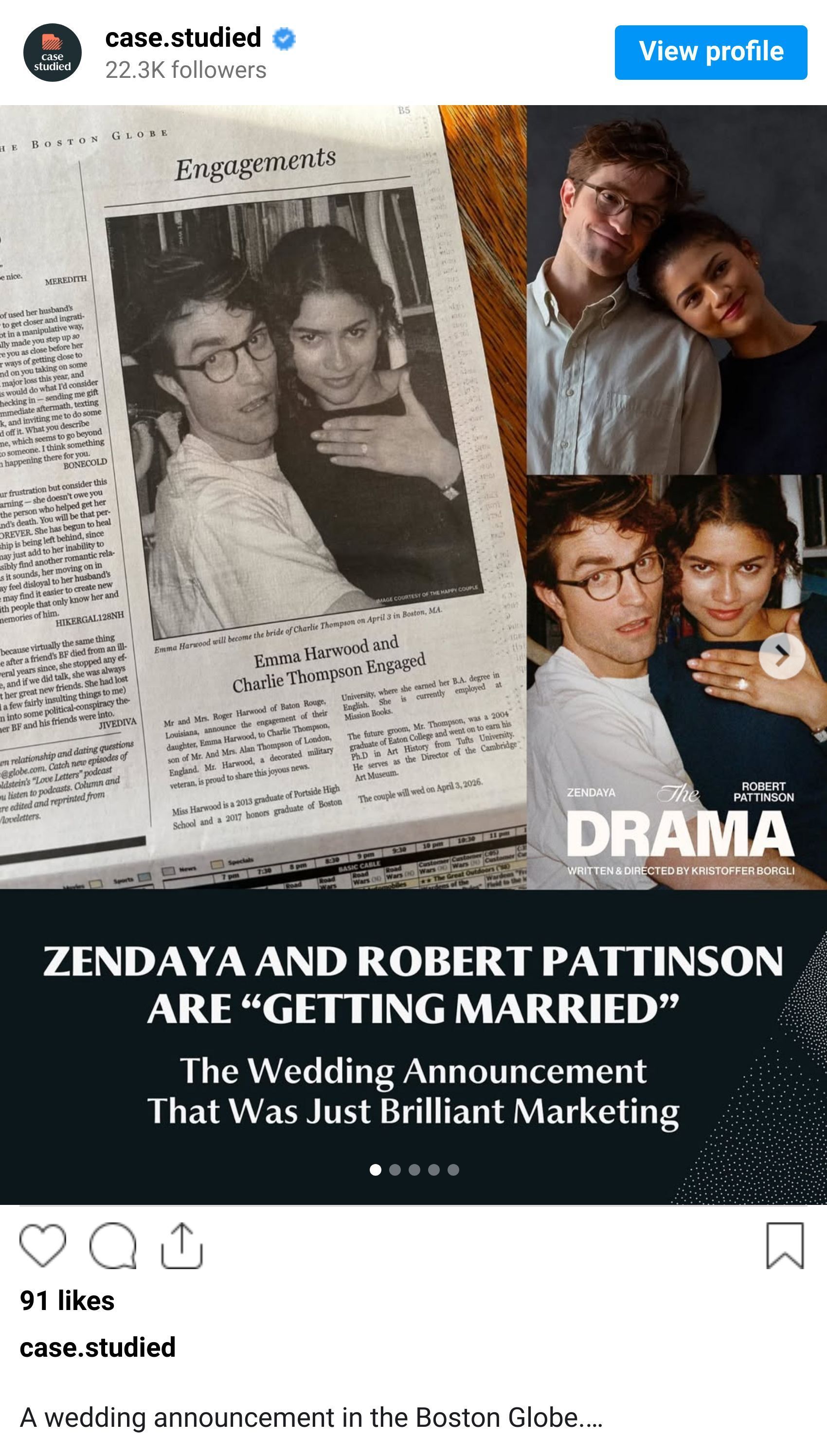
For The Drama, starring Zendaya and Robert Pattinson, A24 placed a traditional wedding-style engagement announcement in a newspaper featuring the two actors. There was no studio branding, no release date, and no immediate explanation. Readers encountered it exactly as they would a real engagement notice: quietly and without context. Screenshots circulated online, speculation followed, and only later did audiences learn it was tied to a film about a couple unraveling during their engagement.
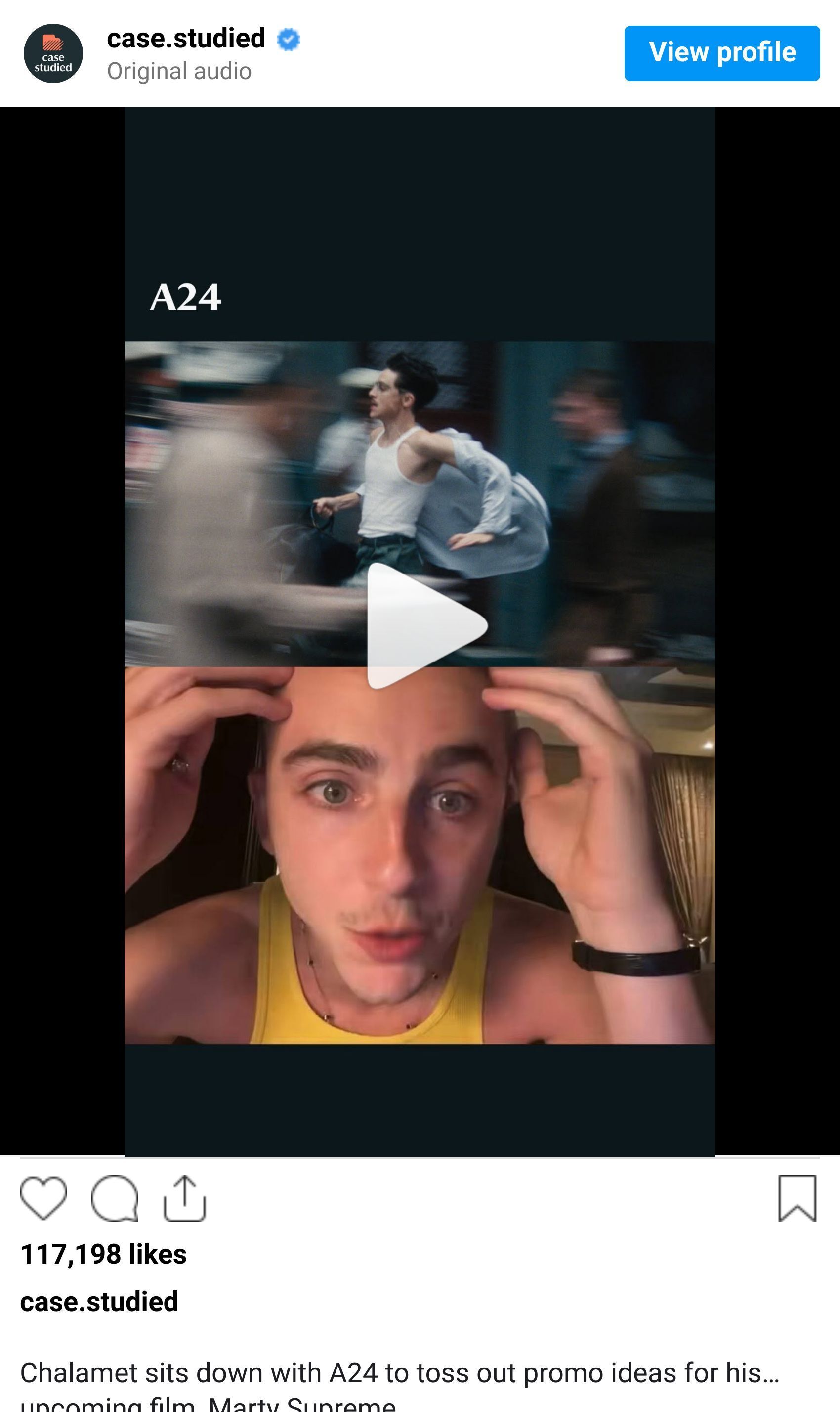
For Marty Supreme, the studio staged what appeared to be a leaked Zoom call featuring Timothée Chalamet. The actor met with the marketing team and shared increasingly ridiculous ideas for the movie’s promo. The clip looked unofficial and unfinished, like something not meant for public release. And it organically spread because people weren’t sure whether they were watching a rehearsal, a real leak, or a joke.
In both of these campaigns, A24 resisted the urge to immediately explain itself. Instead, it trusted that confusion, handled carefully, would gain stronger traction.
The Results

The Drama engagement announcement generated widespread social conversation and coverage across entertainment and mainstream media. Outlets dissected both the stunt and the film’s themes once the reveal landed. Screenshots of the announcement circulated widely before many people even knew a new Zendaya and Pattinson project existed.
The Marty Supreme Zoom clip followed a similar trajectory, earning press attention not because of scale, but because of confusion. And while there’s no performance data publicly available, the film’s unconventional promotional push certainly contributed to real-world momentum.
Marty Supreme opened in limited release and made $875,000 from six theaters, marking the highest per-theater average for A24. It made $27.3 million over the four-day Christmas weekend during its wide release and as of Jan. 6, 2026, it’s A24’s highest-grossing film in the U.K.
The Takeaways
1) Resist the urge to over-explain.
Notably, A24 often resists over-explaining its stunts, even after they go viral. With both The Drama and Marty Supreme campaigns, the studio allowed speculation to run before stepping in with clarity. And that withholding invited interpretation and intrigue.
There’s a common instinct for brands to control the narrative at every step. But sometimes, stepping back and letting people interpret, debate, or even misunderstand briefly can create stronger engagement. Tightly managed messaging has its place but consider the other areas where ambiguity can be useful.
2) Recognize your audience’s acumen.
A24 assumes its audience is smart, skeptical, and online. That’s why its campaigns feel more like inside jokes than announcements. It’s also why they were shared without being forced.
No matter who your audience is, they’re fluent in some specific culture or profession. So when you craft messaging, be intentional about speaking to their literacy. Even subtle recognition of their fluency can help your brand earn trust.
3) Earned media can scale without inflating budgets.
Many of A24’s most effective moments—fake Tinder profiles, character Twitter accounts, leaked Zoom calls—were relatively low-cost executions that traveled far. Why? They were culturally legible and press-worthy. The amplification came from people wanting to talk about what they’d just seen.
For marketers facing tighter budgets, this reinforces the value of designing for shareability and coverage. A well-placed, well-timed idea can outperform a larger buy if it gives audiences and media something genuinely unexpected to react to.
End the search: Vendry makes it simple to find your next agency partner. Share your needs and get connected with vetted, top-tier options in under a week—at no cost to you.